Why Your Laboratory Formula May Fail at Production Scale: The Importance of Cosmetic Scale-Up

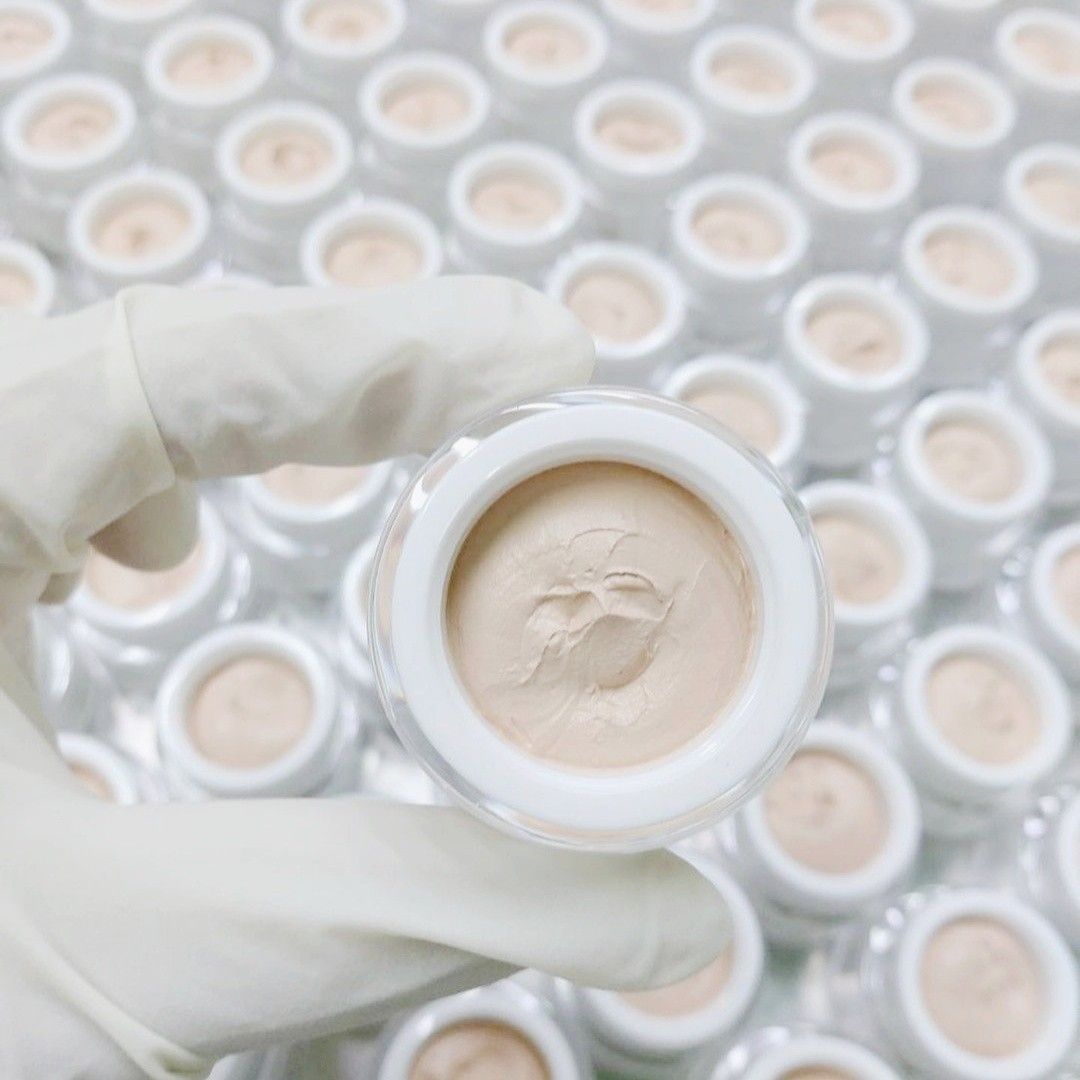
A laboratory sample looks perfect.
The texture is right. The colour is right. The viscosity is within specification. The client approves the sample, and the formula appears ready for production.
Then the first industrial batch is made — and something is different.
The cream may be thinner or thicker. The emulsion may have a different appearance. The product may feel different on the skin. Sometimes the difference is subtle; sometimes it is immediately obvious.
This does not necessarily mean that the laboratory formula was wrong.
It means that a laboratory formula and a manufacturing process are not the same thing.
This is why scale-up is one of the most important stages of cosmetic product development.
At A&T Formulation, we see scale-up not as a simple mathematical exercise of multiplying a 200 g formula by 1,000, but as a controlled transition from laboratory development to reproducible industrial manufacturing.
What Is Scale-Up in Cosmetic Product Development?
In simple terms, scale-up is the process of transferring a formulation and its manufacturing process from laboratory scale to progressively larger production volumes.
The objective is not simply to produce more kilograms of the same product.
The objective is to reproduce the same essential product characteristics at a larger scale.
That distinction is critical.
A 200 g laboratory batch and a 2,000 kg production batch can contain exactly the same theoretical percentages of ingredients while behaving differently because the conditions under which those ingredients are mixed, heated, homogenised, cooled and processed are different.
Professional cosmetic literature specifically recognises that laboratory-scale preparations do not necessarily translate directly to manufacturing conditions. The Delivery System Handbook for Personal Care and Cosmetic Products notes that laboratory equipment generally does not correlate directly with plant equipment and that an intermediate stage is often necessary during scale-up.
In practice, scale-up is therefore a process-development stage, not simply a calculation.
Why Doesn't a Laboratory Sample Behave Like a Production Batch?
There is no single reason.
Several variables change simultaneously when moving from a small laboratory vessel to industrial equipment.
The most important ones include:
- measurement and weighing;
- equipment geometry;
- mixing and shear;
- heating and cooling;
- homogenisation;
- processing time;
- order of addition;
- raw-material characteristics;
- air incorporation;
- and the physical behaviour of the formulation itself.
For emulsions in particular, these variables can have a substantial influence on the final product.
The Delivery System Handbook describes experiments in which identical raw materials produced significantly different viscosity and specific gravity depending on the processing conditions used.
This leads to a fundamental concept in formulation:
The formula is not always independent of the process.
In some systems, the manufacturing process is effectively part of the product.
1. Measurement Becomes Different at Different Scales
One of the first problems is surprisingly simple: weighing is not perfectly exact.
Suppose a laboratory formulator is preparing a 200 g sample and needs a very small quantity of an ingredient.
The absolute measurement error may be small in grams, but relative to the amount being weighed, it can represent a meaningful percentage difference.
When the same formulation is produced on a much larger scale, the same absolute measurement uncertainty may represent a much smaller proportion of the total batch.
This means that the laboratory sample and the production batch can sometimes have slightly different actual compositions even when the formulation percentages are theoretically identical.
The issue becomes particularly relevant for ingredients used at low concentrations.
There is also another side to the problem: industrial production may introduce its own weighing, transfer and handling tolerances.
This is why a scale-up process should not assume that multiplying every laboratory quantity by the same factor automatically guarantees an identical batch.
The target is reproducibility, not simply mathematical proportionality.
2. Laboratory and Industrial Equipment Are Rarely Identical
This is probably the most obvious difference — and one of the most important.
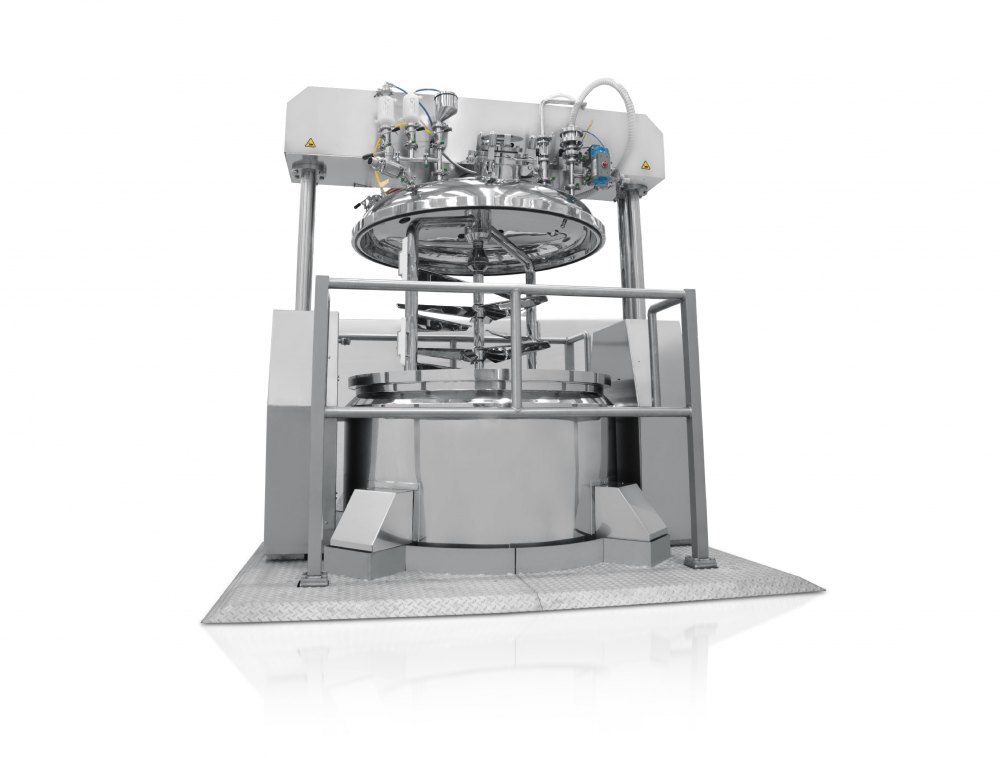
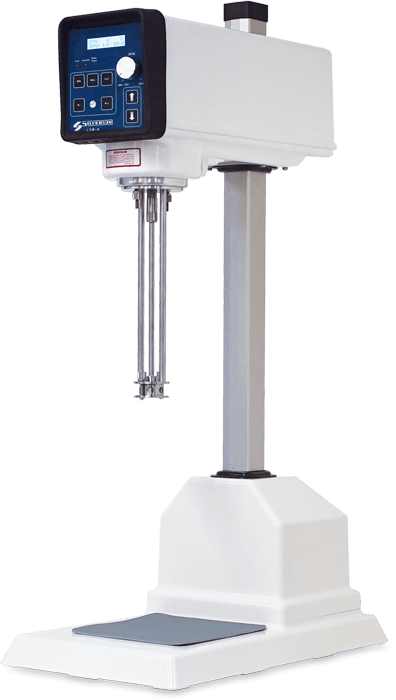
A laboratory may use a small high-shear mixer, homogeniser or propeller mixer.
The manufacturing plant may use a completely different vessel and mixing system.
Even when both machines are described as "homogenisers", their geometry, rotor design, working volume and operating conditions may differ.
The result is that the formulation can experience a different mechanical environment.
Mixing speed is only one part of the equation.
The relationship between the equipment and the batch volume also matters.
A mixer turning at a particular number of revolutions per minute in a small laboratory vessel does not necessarily produce the same processing conditions as the same nominal speed in a much larger vessel.
This is why rpm alone is not a sufficient description of a scale-up process.
The formulator needs to understand what the equipment is actually doing to the product.
3. Shear Can Change the Structure of the Formula
Shear is particularly important for emulsions, suspensions and structured cosmetic systems.
During mixing and homogenisation, mechanical energy can break droplets into smaller particles or droplets and influence their distribution.
The resulting particle size can affect viscosity, appearance, texture and stability.
The Handbook of Cosmetic Science and Technology explains that, particularly in emulsions, the energy used during processing can determine particle size and distribution, which in turn can influence product stability. It also notes that large-scale production may require a specific production trial because the manufacturing method can have a significant effect on stability.
This is one reason why simply saying:
"We used the same mixing speed."
does not necessarily mean that the laboratory and industrial batches experienced the same process.
What matters is the overall mechanical and thermal history of the product.
4. Heating and Cooling Behave Differently at Larger Scale
Temperature is another major scale-up variable.
A small laboratory vessel can heat up and cool down relatively quickly.
A large production vessel has a much greater mass of product, and the relationship between the product and the vessel's heating or cooling system is different.
As a result, the product may spend more or less time at particular temperatures.
This can matter enormously for an emulsion.
The Delivery System Handbook identifies the temperature of the oil and water phases, heating rate, mixing method, mixing rate and cooling rate as factors that influence emulsion properties.
Large-scale production can therefore require adjustments to:
- heating rates;
- cooling rates;
- holding times;
- order of addition;
- mixing conditions;
- and homogenisation parameters.
These changes do not necessarily mean that the formula itself has failed.
They may simply be necessary to reproduce the same final structure using different equipment.
Get the latest posts
Unlock a world of knowledge and inspiration - subscribe to our blog for exclusive content, expert insights, and exciting updates!
5. Raw Materials Are Not Always Identical
This is an area that is often underestimated.
A laboratory sample may be prepared using a material supplied directly by an ingredient manufacturer for development purposes.
The production batch may use the commercial raw material that will actually be purchased for manufacturing.
Even when two materials have the same INCI name, their physical and chemical characteristics can vary within the supplier's specification.
This can be particularly relevant for naturally derived materials.
A botanical extract, for example, may be influenced by factors such as:
- growing conditions;
- harvest;
- geographical origin;
- processing;
- storage;
- and the characteristics of the particular batch.
These differences can influence parameters such as colour, odour, viscosity or other physical properties.
The Handbook of Cosmetic Science and Technology also highlights the importance of raw-material supplier changes and explains that materials with the same nominal designation are not necessarily chemically identical. It recommends evaluating the effect of raw-material changes rather than assuming that a substitute will behave identically.
For scale-up, this means that the final production raw materials should be considered part of the development process.
6. Air Can Become a Surprisingly Important Variable
High-speed mixing can sometimes introduce air into a formulation.
At laboratory scale, the amount of air incorporated may be relatively small.
At production scale, differences in vessel geometry, mixer position, fill level and mixing conditions can change the amount of air incorporated into the batch.
This can influence:
- specific gravity;
- apparent viscosity;
- appearance;
- texture;
- filling behaviour;
- and sometimes stability.
The Delivery System Handbook specifically notes that high mixing rates can entrain air and that this can lead to lower specific gravity and increased viscosity.
This is another example of why the manufacturing process cannot be treated as an afterthought.
Why We Prefer a Step-by-Step Scale-Up
One of the most important principles in our approach is not jumping directly from the laboratory batch to the final production size whenever the formulation or manufacturing process warrants intermediate validation.
For example, a development process might look conceptually like this:
Laboratory: 200 g
↓
Intermediate scale: approximately 7 kg
↓
Further scale-up: approximately 20 kg
↓
Pilot or pre-production scale
↓
Final production batch
The exact stages depend on the product, equipment and final batch size.
A commonly used practical approach is to increase the batch by a manageable factor at each stage rather than making one enormous jump. The exact multiplier should be determined by the process and equipment rather than treated as a universal rule.
The professional literature specifically describes the need for an intermediate phase between laboratory and plant conditions and recommends evaluating products made at different scale-up levels, including accelerated stability testing where appropriate.
The reason is straightforward:
Every intermediate batch gives us information.
If something changes at 7 kg, we can investigate it before reaching 500 kg.
If the 7 kg batch behaves correctly but the 20 kg batch changes, we have narrowed down where the problem appears.
That is much easier to solve than discovering the problem for the first time in a full production batch.
What Do We Check at Each Scale-Up Stage?
Scale-up should not be based solely on whether the product "looks right".
At each stage, relevant parameters can be compared with the approved laboratory reference.
Depending on the formulation, these may include:
- appearance;
- colour;
- odour;
- pH;
- viscosity;
- density or specific gravity;
- particle or droplet characteristics;
- texture;
- processing behaviour;
- filling behaviour;
- and other product-specific specifications.
The client can also evaluate the sample.
This is important because instrumental measurements and human sensory evaluation answer different questions.
A cream may have a viscosity value close to the laboratory sample while still feeling noticeably different during application.
Conversely, a small numerical difference may have little practical significance if the sensory characteristics remain within the intended product profile.
The purpose is therefore not to force every number to be mathematically identical.
It is to establish that the manufacturing process consistently produces the intended product.
Scale-Up Is Also a Learning Process
An important misconception is that the scale-up stage should simply confirm that everything already works.
In reality, scale-up is often where the development team learns how the formulation behaves under manufacturing conditions.
A laboratory formulation can reveal whether a concept works.
Scale-up reveals whether the process can reproduce that concept reliably.
This distinction is particularly important for emulsions and other structurally sensitive systems.
The literature describes how even products made from identical raw-material lots can vary significantly when processing conditions change. Differences in particle size, crystalline properties, viscosity and specific gravity can result from changes in processing.
That is why experienced formulators pay close attention to process parameters rather than treating the formula percentage sheet as the complete manufacturing solution.
What Happens During the First Industrial Batch?
Even after successful laboratory and intermediate-scale batches, the first industrial production can still reveal differences.
This is not unusual.
The commercial vessel may have different geometry. Heat transfer may be different. Mixing may not reproduce the same shear environment. Filling equipment introduces another set of conditions.
For this reason, the first production batch should be treated as an important validation step rather than simply a larger version of the laboratory experiment.
The Handbook of Cosmetic Science and Technology specifically recommends evaluating stability using samples produced under actual production conditions, particularly when a formulation is manufactured on a large scale for the first time.
This is where scale-up and stability testing become closely connected.
The A&T Formulation Approach
From our perspective as cosmetic product developers, the most important principle is simple:
We do not consider a laboratory sample to be the end of formulation development.
The laboratory gives us the formulation target.
Scale-up establishes how that target can be reproduced using real manufacturing equipment and commercial raw materials.
When necessary, the manufacturing process may need to be adapted — for example, in terms of mixing sequence, mixing speed, homogenisation, temperature profile or processing time — while preserving the composition and essential characteristics of the approved product. This is also reflected in our own product-development documentation, which recognises industrial scale-up as a stage that can require process adjustments.
This is why communication between the formulator, manufacturer and client is so important.
At each stage, we want to answer three questions:
Does the batch behave correctly during production?
Does the finished product match the approved laboratory target?
Can the process be repeated reliably?
If the answer is yes, the product is much better positioned for commercial manufacturing.
The Bottom Line
A successful cosmetic formula is not simply a list of percentages.
It is a combination of composition, raw materials, equipment and process conditions.
A laboratory sample may be perfectly formulated and still behave differently when produced at industrial scale. Differences in measurement, raw materials, equipment geometry, mixing, shear, heating, cooling, processing time and air incorporation can all influence the final product.
That is why scale-up should be treated as a controlled development process rather than a single multiplication calculation.
Moving progressively from laboratory scale to intermediate and pilot batches allows the formulator to identify problems early, compare measurable parameters, evaluate sensory properties and optimise the manufacturing process before full commercial production.
For us, this is what successful scale-up means:
not making a larger laboratory batch, but learning how to make the same product reliably at a larger scale.
That is the real bridge between cosmetic formulation and commercial manufacturing.
References
- Barel, A. O., Paye, M., & Maibach, H. I. (Eds.). (2009). Handbook of Cosmetic Science and Technology, 3rd ed. Informa Healthcare. The source discusses raw-material variability, processing issues and the importance of evaluating first large-scale production batches.
- Rosen, M. R. (Ed.). (2005). Delivery System Handbook for Personal Care and Cosmetic Products: Technology, Applications, and Formulations. William Andrew Publishing. The source specifically discusses laboratory-to-manufacturing scale-up, intermediate scale, equipment differences, processing variability, heating, cooling, mixing and the effects of processing on emulsion properties.
- Benson, H. A. E., Roberts, M. S., Leite-Silva, V. R., & Walters, K. A. (Eds.). (2019). Cosmetic Formulation: Principles and Practice. CRC Press. The source addresses manufacturing process variables, equipment, mixing, heating, cooling and the importance of controlled manufacturing procedures.
- A&T Formulation – Product Development Documentation. (2026). Internal development framework describing laboratory process development and industrial scale-up, including potential adjustments to order of addition, mixing sequence, mixing speed, homogenisation, temperature profile and processing time when transferring a formulation to commercial manufacturing conditions.
Related posts
Cosmetic Emulsions: Formulation, Common Emulsifiers & Stability Insights