How Much Does It Cost to Start a Skincare Brand in 2026?

How Much Does It Cost to Start a Skincare Brand in 2026?
Starting a skincare brand has never been more accessible. Contract manufacturers, online commerce, social media and specialist suppliers make it possible for a relatively small company to develop and launch a cosmetic product without owning a factory or laboratory.
So how do you actually start a skincare brand in 2026?
We have created a calculator to help you navigate the costs involved.
The calculator is particularly useful because the cost of a skincare product is not determined by one number.
A standard formulation in standard packaging, produced at a relatively modest volume, is a very different project from a technically complex active product with specialist packaging and additional testing.
The rest of this article explains the main variables behind that calculation.
1. Is 2026 a Good Time to Start a Skincare Brand?
Yes—but the opportunity comes with higher expectations.
It is easier than before to find manufacturers, packaging suppliers, formulation partners and e-commerce infrastructure. At the same time, consumers have access to an enormous number of skincare products, making differentiation harder.
The important question is therefore not simply:
“Can I launch a skincare product?”
It is:
“Can I develop a product that solves a meaningful problem, justify its price and build a commercially sustainable business around it?”
A new brand needs more than attractive packaging and a list of fashionable ingredients.
It needs a defined customer, a credible product concept, an appropriate formulation, evidence supporting its claims, compliant packaging and a business model that can survive beyond the first production run.
2. Define Your Customer and the Problem You Want to Solve
Before developing a formula, define who the product is actually for.
A useful starting framework is:
This is more useful than defining a target customer simply as “women aged 25–45 who care about skincare.”
A product designed for people who want a lightweight moisturiser for use under makeup has a different brief from one designed for consumers seeking a richer night treatment.
The difference affects the formulation, sensory profile, packaging, claims, price and potentially even the manufacturing process.
Professional product-development literature treats customer needs and product definition as part of the development process rather than as separate marketing exercises.
A simple customer definition
Try to complete this sentence:
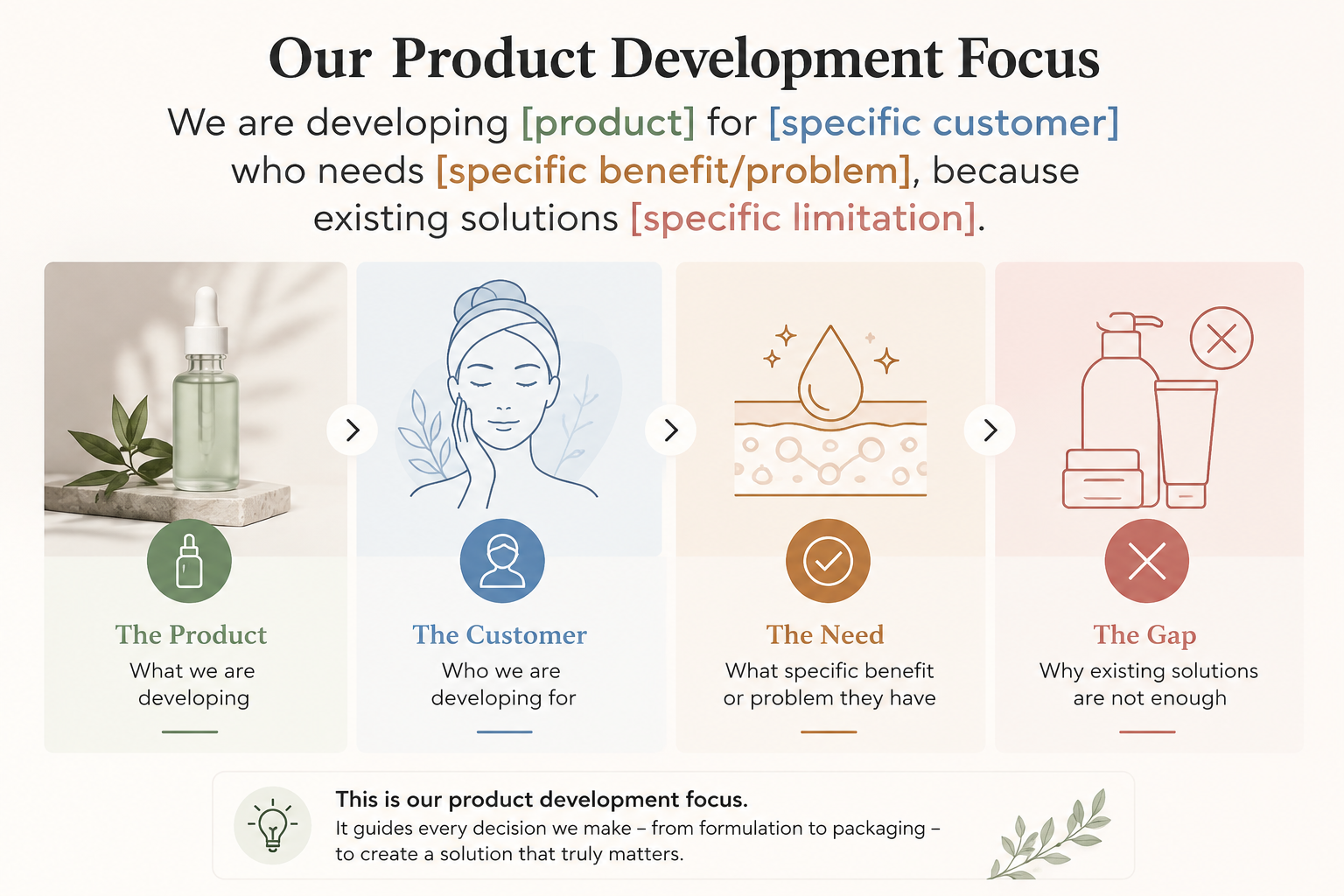
If you cannot complete it clearly, the product concept probably needs more work.
3. Validate the Idea Before You Develop the Product
One of the most expensive mistakes a new skincare founder can make is developing a product before establishing whether there is meaningful demand for the concept.
Validation does not require a huge research budget.
You can use:
- competitor analysis;
- customer interviews;
- surveys;
- landing pages;
- waitlists;
- prototype feedback;
- small consumer tests;
- pre-orders where appropriate;
- search and keyword research.
But be careful with social media.
Likes are not the same as purchase intent.
Someone saying that they “love the idea” is not necessarily someone willing to pay €40 for it.
The strongest validation combines what people say with what they actually do.
4. Define the Brand Positioning
Once the customer and problem are clearer, define what the brand stands for.
A useful skincare brand should be able to answer:
- Who is this for?
- What problem does it address?
- What makes the approach different?
- Why should the customer believe the product?
- Why is it worth its price?
This is positioning—not simply storytelling.
Your positioning should also influence the product itself.
A premium clinical skincare brand, a minimalist sensitive-skin brand and a botanical lifestyle brand may all sell moisturisers, but their formulation priorities, packaging, claims, sensory experience and price architecture can be completely different.
The brand should therefore be defined before the formulation is locked, not built around whatever formula happens to be available.
5. Build the Product Concept Before Formulating
Do not start by sending a manufacturer a list of ingredients.
Start with a Product Brief.
The brief should define the requirements the formulation needs to satisfy.
This creates a technical bridge between the commercial idea and the formulation laboratory.
6. Decide How the Product Will Be Developed
Private Label or Custom Development? Our questionnaire will help you determine which option is right for you.
7. Choose the Right Formulation and Manufacturing Partner
Choosing a manufacturer based only on the lowest quoted unit price is rarely a good strategy.
Ask potential partners about:
- formulation capabilities;
- development process;
- testing;
- documentation;
- GMP systems;
- MOQ;
- lead times;
- raw-material sourcing;
- packaging sourcing;
- pilot production;
- scale-up;
- quality control;
- batch specifications;
- formula ownership and IP;
- technology transfer;
- regulatory support;
- change control.
A particularly important question is:
What happens when something changes?
What happens if an ingredient becomes unavailable?
What happens if a packaging supplier changes?
What happens if a manufacturing process needs modification?
A professional development process needs a way of controlling these changes.
New-product-development literature similarly emphasises project control, quality, schedule, resources, risk and cross-functional coordination rather than treating product development as a single isolated technical task.
8. Develop the Formula: From Brief to Final Product
Professional formulation is iterative.
A typical process may look like:
Brief → prototype → evaluation → modification → further prototype → testing → final formula
The first laboratory sample is therefore not necessarily the final product.
A formulator may need to modify the formulation because of:
- instability;
- viscosity;
- sensory characteristics;
- pH;
- preservation;
- ingredient compatibility;
- packaging requirements;
- processing requirements;
- or cost.
The important distinction is between subjective preference and technical evaluation.
“I don't like the texture” is useful feedback, but it is not yet a formulation specification.
More useful questions are:
- Is the product too slow to spread?
- Is the after-feel too occlusive?
- Does tack persist?
- Does pilling occur?
- Is the absorption time appropriate?
- Does the viscosity change over time?
- Is the dispensing behaviour suitable?
This turns consumer feedback into information that a formulator can actually use.
9. Test Safety, Stability, Performance and Consumer Experience
Not every skincare product needs every possible test.
The testing strategy should be driven by the product, formulation, intended claims, target market and risk profile.
Different tests answer different questions.
The key principle is therefore:
Do not test everything simply because a competitor does. Test what the product and its claims require.
10. Build Claims Around Evidence
Claims should not be invented after the formulation is finished.
A better approach is:
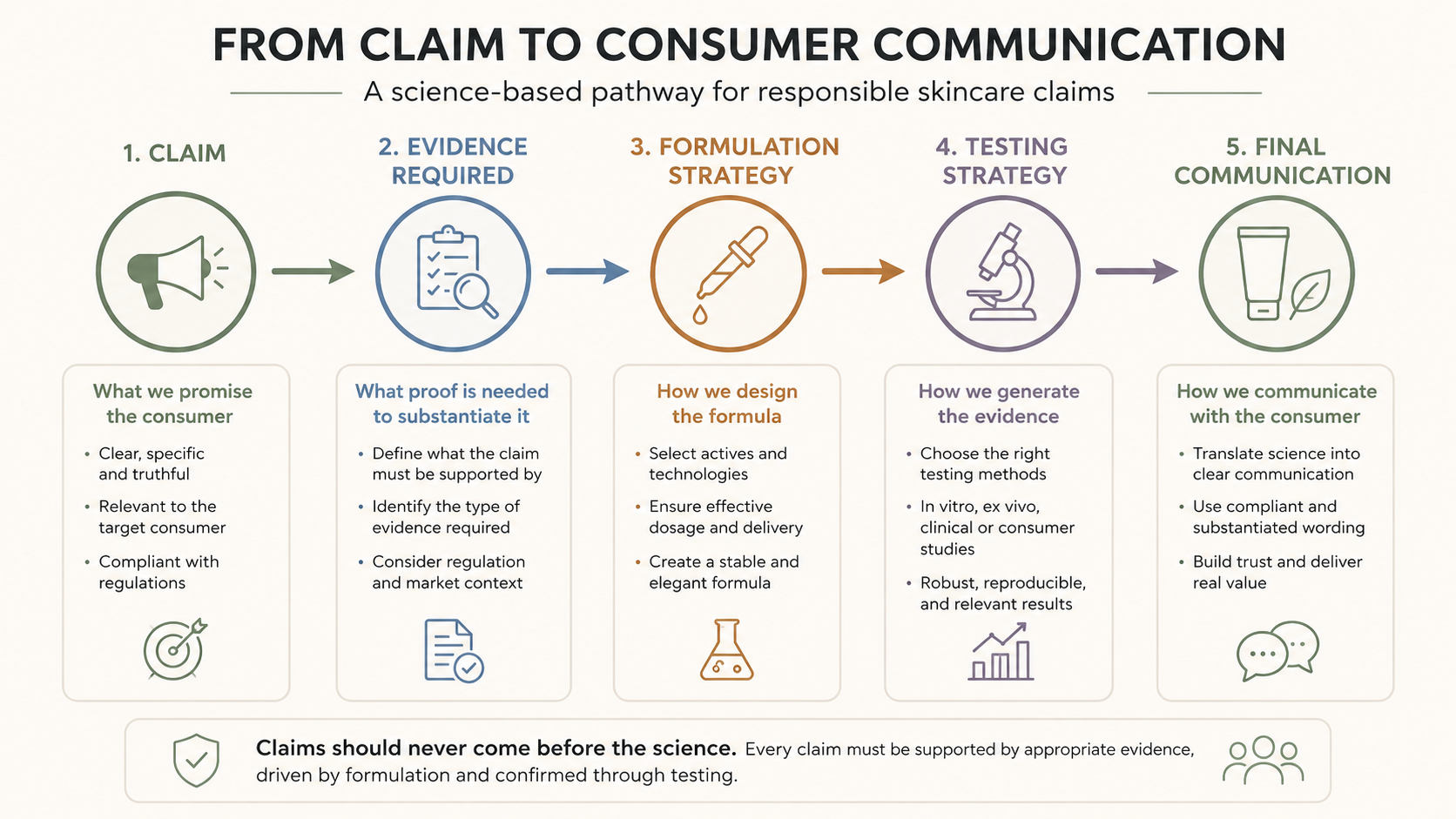
For example, there is an important difference between:
“Contains hyaluronic acid”
and a product claim describing a specific cosmetic benefit.
The first is primarily an ingredient statement.
The second may require appropriate evidence to substantiate what the product is claimed to do.
This is why claims should be discussed during product development.
A formulation may need to be modified depending on the intended claim, while the testing strategy may also change.
The goal is not to make the strongest-sounding claim possible.
It is to make a claim that the finished product can legitimately support.
Get the latest posts
Unlock a world of knowledge and inspiration - subscribe to our blog for exclusive content, expert insights, and exciting updates!
11. Choose Packaging That Works With the Formula
Packaging is not simply a branding decision.
It is part of the product system.
Important considerations can include:
- formula compatibility;
- oxygen exposure;
- light exposure;
- viscosity;
- dispensing;
- filling;
- stability;
- usability;
- transport;
- leakage;
- sustainability;
- visual positioning.
The professional cosmetic literature specifically highlights the interaction between formulation, manufacturing and packaging. Differences in packaging materials can affect oxygen permeability, thermal behaviour and other properties, while changes in packaging can require additional evaluation.
This is why packaging should be considered early.
A beautiful package that does not work with the formulation is not a successful package.
12. Prepare Regulatory Compliance Before Launch
Cosmetic regulation is market-specific.
The requirements for selling a cosmetic product in the EU are not identical to those in the United States or other markets.
The EU's CosIng database provides information on cosmetic substances and ingredients, including their regulatory status and references to the Cosmetics Regulation and SCCS opinions.
CPNP should also not be thought of as a conventional “product approval fee”. It is the EU cosmetic product notification system.
Most importantly, compliance should be considered before production and packaging commitments are finalised.
13. What Has Changed for Skincare Brands in 2026?
If an article is specifically about starting a skincare brand in 2026, the year should mean something.
There are several current regulatory developments worth understanding.
Packaging: PPWR
The EU Packaging and Packaging Waste Regulation (PPWR), Regulation (EU) 2025/40, generally applies from 12 August 2026. It establishes requirements covering packaging and packaging waste, including manufacturing, composition and recyclability/recoverability.
Not every PPWR requirement applies immediately. Many measures are phased in later, including important requirements scheduled for 2030.
For skincare brands, this means packaging decisions increasingly need to consider regulatory requirements alongside cost, aesthetics and functionality.
Fragrance allergen labelling
Commission Regulation (EU) 2023/1545 introduced individual labelling requirements for 56 additional fragrance allergens.
As of 31 July 2026, cosmetic products that do not comply with the new fragrance-allergen labelling requirements may no longer be placed on the EU market. Products placed on the market before that date may remain available during the transition period, subject to the applicable conditions, until 31 July 2028.
For a new brand, this illustrates why ingredient review, formulation, claims, artwork and regulatory work need to be coordinated.
A change in regulatory requirements can affect not only the formula but also the packaging artwork and inventory already purchased.
Ingredient restrictions continue to evolve
The EU also continues to update the regulatory status of cosmetic ingredients, including measures relating to CMR substances. Current Commission information shows further regulatory measures being prepared and applied on different timelines.
The practical lesson is simple:
Regulatory review should happen before committing to large production volumes.
14. Calculate the Real Cost of Your Product
15. Understand MOQ and Working Capital
MOQ means Minimum Order Quantity.
It can have a major effect on the cash required to launch.
For example, imagine you want to manufacture 2,000 units but the packaging supplier requires 5,000 units.
You may need to purchase all 5,000.
The remaining 3,000 become inventory for a future production run.
This is not necessarily waste. It may actually make the next production run faster.
But it means that:
the amount of cash required upfront can be greater than the value of the first batch of finished products.
The same principle applies to specialist raw materials.
A supplier may sell an ingredient in a quantity greater than the amount required for your first production run. Subject to appropriate storage and shelf-life requirements, the remaining material may then be available for future manufacturing.
This is one reason why founders should model working capital, not just unit cost.
16. How Much Does It Cost to Start a Skincare Brand?
For a custom-developed skincare product, a practical initial planning benchmark is approximately €10,000–€20,000 per product.
This is not a universal industry price and should not be treated as a quotation.
The actual project cost depends on:
- formulation complexity;
- development iterations;
- testing;
- regulatory requirements;
- packaging;
- MOQ;
- production volume;
- branding;
- design;
- target markets;
- inventory;
- and launch strategy.
For custom product development specifically, planning from approximately €2,500 per product upward is a reasonable starting point for formulation and prototyping. More complex formulations or additional development requirements can increase this substantially.
Use the calculator before committing to a budget
Our Skincare Product Budget Calculator is designed to help founders build an indicative project estimate.
It considers variables including product type, formulation development, production quantity, packaging, testing, additional markets, trademark registration and design budget. The calculator also distinguishes between initial investment and recurring production-related costs.
The calculation is for planning purposes only. It is not a quotation, and it does not include every possible business expense such as marketing, warehousing, taxes, distribution margins or payment fees.
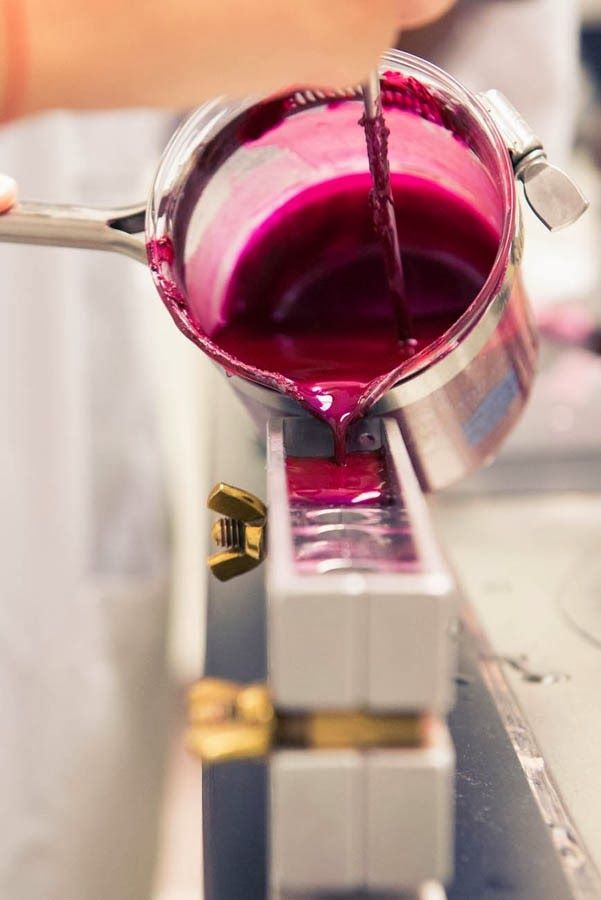
17. Scale From Laboratory to Commercial Production
This is one of the most underestimated stages of skincare development.
Laboratory-scale production ≠ commercial-scale production.
A laboratory batch may use:
- different equipment;
- different mixing conditions;
- different shear;
- different heating and cooling rates;
- different processing times;
- different order of addition.
At commercial scale, these parameters can change.
This is particularly important for emulsions, where processing energy can affect particle size and distribution and therefore influence stability. Professional cosmetic literature recommends evaluating material produced under actual production conditions, and in some cases a trial production batch may be appropriate before commercialisation.
A commercial scale-up may therefore involve:
Laboratory prototype → pilot/trial batch → production process → QC specifications → commercial batch → master sample → repeat production
Once the manufacturing process has been validated, changes to parameters such as heating, cooling, mixing or order of addition may require further evaluation.
Scale-up is not simply “making more of the same formula.”
It is translating a formulation into a reproducible manufacturing process.
18. Build the Launch Strategy
A launch does not begin when the product is uploaded to Shopify.
Before launch, decide:
What is the hero SKU?
A focused brand may be better served by one strong product than by launching eight products simultaneously.
Where will you sell?
Potential channels include:
- DTC e-commerce;
- marketplaces;
- professional channels;
- retail;
- distributors.
How will customers discover the product?
Possible channels include:
- SEO;
- educational content;
- email;
- sampling;
- creator partnerships;
- social media;
- paid advertising;
- professional recommendations.
The right combination depends on the customer and positioning.
A clinical skincare product aimed at professionals may require a very different acquisition strategy from a lifestyle-oriented DTC brand.
19. Launch, Measure and Improve
Launching the product is not the end of product development.
It creates a new source of information.
Track:
- conversion rate;
- average order value;
- repeat purchase;
- customer acquisition cost;
- gross margin;
- reviews;
- returns;
- complaints;
- customer feedback;
- reorder timing;
- product performance.
Then feed that information back into product development.
A customer complaint about dispensing may reveal a packaging problem.
Repeated feedback about texture may indicate a sensory optimisation opportunity.
Poor repeat purchase may indicate a mismatch between positioning, product experience and customer expectations.
New-product-development systems are most useful when market feedback is fed back into the development process rather than treating launch as the final stage.
20. Common Mistakes New Skincare Founders Make
21. The Real Process of Starting a Skincare Brand
Starting a skincare brand is often presented as a short checklist:
Find a product → put your logo on it → build a website → advertise.
That can describe a very simple private-label launch.
It does not describe the full process of building a differentiated skincare product.
The most important decisions are therefore made before the product reaches the market.
A well-developed formula, suitable packaging, validated claims, controlled manufacturing process and realistic commercial model all reduce the risk of discovering expensive problems later.
For founders considering custom skincare formulation, this is the fundamental difference between simply putting a product on the market and building a product that can become the foundation of a brand.
Frequently Asked Questions
How much does it cost to start a skincare brand in 2026?
For a custom-developed skincare product, €10,000–€20,000 per product is a useful initial planning benchmark. The actual investment depends on formulation complexity, testing, packaging, MOQ, production volume, regulatory requirements and the commercial strategy.
How much does custom skincare formulation cost?
Custom skincare product development and prototyping should be planned from approximately €2,500 per product upward. More complex formulations, additional development rounds, specialist ingredients and additional testing can increase the total.
Is private label skincare cheaper than custom formulation?
Private label can reduce development time and upfront formulation work because an existing product is already available. In the long term, however, private label can be more expensive. The initial unit cost is often higher, and pricing can vary significantly between manufacturers. Because the formulation and its underlying cost structure are controlled by the manufacturer, the brand has limited influence over how the final price is determined.
What is MOQ in skincare manufacturing?
MOQ means Minimum Order Quantity. It is the minimum quantity a manufacturer or supplier will produce or supply. Packaging and raw-material MOQs can sometimes be higher than the number of finished products you initially intend to manufacture. In general, 2,000–3,000 units is a typical minimum production quantity for manufacturing under standard industrial conditions. Quantities between 500 and 1,000 units are considered very low for commercial production. If a manufacturer is willing to accept such a small production run, they will often charge a higher unit price or an additional small-batch surcharge because the fixed costs of production are spread across fewer units.
Do all skincare products need the same testing?
No. Testing requirements depend on the formulation, product type, intended use, claims, target market and risk profile. Stability, microbiological, preservation, safety, compatibility and consumer testing answer different questions and should be selected accordingly.
Can I start a skincare brand with a small budget?
Yes, but the project needs to be designed accordingly. A smaller launch can use a limited product range, standard packaging, controlled production quantities and a focused commercial strategy. Reducing unnecessary complexity is preferable to removing essential formulation, safety or compliance work.
References
Professional and Scientific Sources
- Barel, A. O., Paye, M., & Maibach, H. I. (eds.). Handbook of Cosmetic Science and Technology. 3rd ed. Informa Healthcare, 2009.
- Barel, A. O., Paye, M., & Maibach, H. I. (eds.). Handbook of Cosmetic Science and Technology. Stability testing, formulation–manufacturing–packaging interactions and cosmetic product testing.
- Benson, H. A. E., Roberts, M. S., Leite-Silva, V. R., & Walters, K. A. (eds.). Cosmetic Formulation: Principles and Practice. CRC Press, 2019.
- Alexander, K., & Romanowski, P. (eds.). Cosmetic Science: Formulation and Technologies. Springer, 2026.
- Project Management in New Product Development. McGraw-Hill, 2008. Product development, target costing, project integration, launch and market feedback.
- Handbook of New Product Development Management. New product development, product architecture, integration and development management.
Current Regulatory Sources
- European Commission. Cosmetic Products – Scientific and Technical Assessment. Current EU requirements concerning cosmetic product safety assessment.
- European Commission. Cosmetic Ingredient Database – CosIng. Current information on cosmetic substances and regulatory status.
- European Commission. Fragrance Allergens Labelling. Regulation (EU) 2023/1545 and current transition requirements, updated 2026.
- European Commission. Packaging Waste – Packaging and Packaging Waste Regulation (PPWR). Regulation (EU) 2025/40 and implementation timeline.
- European Commission. New EU Rules on Packaging Enter into Application. 11 August 2026.
- European Commission. CMR Substances – Cosmetics. Current and upcoming regulatory measures affecting cosmetic ingredients.
Related posts
Cosmetic Emulsions: Formulation, Common Emulsifiers & Stability Insights