Microemulsion vs. Nanoemulsion vs. Conventional Emulsion: What’s the Difference?

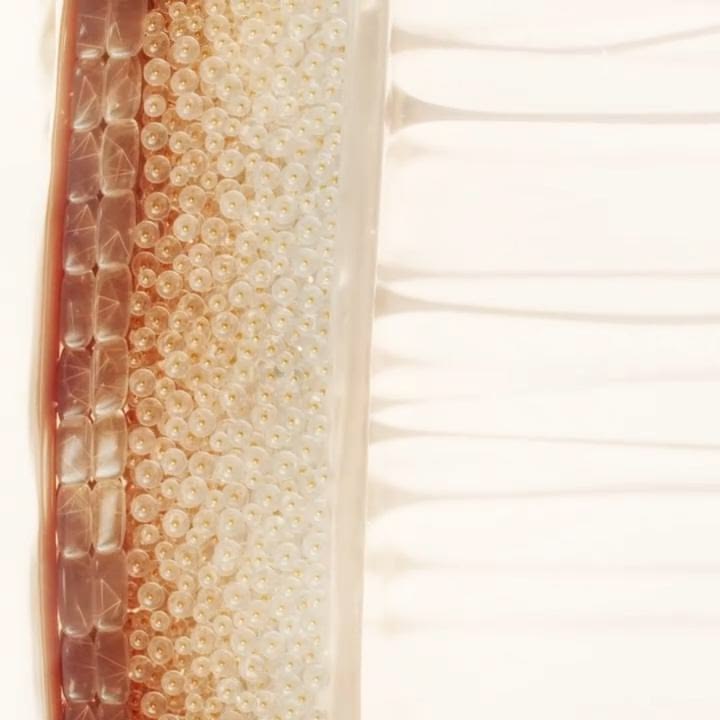
A cosmetic serum can look completely clear, while another product with a similar oil and water composition looks milky white. Both may be perfectly well formulated.
The difference can come down to something that is invisible to the consumer: the size and structure of the dispersed droplets.
Microemulsions, nanoemulsions and conventional emulsions all combine oil and water, but they are not simply three versions of the same technology. They differ in droplet size, stability, appearance, formulation requirements and production methods.
For a cosmetic formulator, choosing between them is not about making the droplets as small as possible. It is about deciding which system makes the most sense for the intended product and its active ingredients.
What Is a Conventional Emulsion?
A conventional emulsion, sometimes called a macroemulsion, is a system in which one liquid is dispersed as droplets within another immiscible liquid.
In a typical cosmetic oil-in-water (O/W) emulsion, small oil droplets are dispersed throughout a continuous water phase. In a water-in-oil (W/O) emulsion, the arrangement is reversed.
Because oil and water naturally tend to separate, conventional emulsions are thermodynamically unstable. They are instead kinetically stabilised through emulsifiers and the structure created around the dispersed droplets.
The droplet size is generally larger than that of nanoemulsions and microemulsions. Conventional equipment such as mechanical mixers and homogenisers can be used to produce these systems, although the resulting droplet-size distribution can be relatively broad.
This is the familiar technology behind many creams, lotions and other everyday cosmetic products.
And conventional does not mean outdated.
For many products, a conventional emulsion may provide exactly the right combination of stability, texture, manufacturing practicality and cost.
What Is a Nanoemulsion?
Nanoemulsions are sometimes called submicron emulsions because their droplets are below 1 micrometre.
Depending on the source and formulation, typical droplet sizes may range from around 100 to 500 nm, although smaller or larger distributions can also occur.
The important point is that nanoemulsions are significantly finer than conventional emulsions.
Their small droplet size changes several of their physical properties.
For example, smaller droplets undergo more pronounced Brownian motion. This can reduce the tendency of droplets to separate under gravity and can contribute to improved physical stability compared with larger conventional emulsions.
Nanoemulsions can also have a very large surface area relative to their volume. That becomes particularly interesting when the emulsion is being used as a vehicle for cosmetic actives.
The Cosmetic Formulation: Principles and Practice literature describes nanoemulsions as useful nanocarrier systems for hydrophobic and amphiphilic cosmetic actives, while also noting that their small droplet size influences their behaviour on the skin. (Cosmetic Formulation: Principles and Practice, 2019, Heather A. E. Benson, Michael S. Roberts, Vânia Rodrigues Leite-Silva & Kenneth A. Walters, eds.)
How Are Nanoemulsions Made?
Producing a nanoemulsion usually requires more specialised processing than making a conventional emulsion.
High-energy techniques can include:
- high-pressure homogenisation;
- microfluidisation;
- ultrasonication;
- and other specialised homogenisation processes.
Low-energy approaches, including phase inversion techniques, have also been investigated.
The choice of method matters because the manufacturing process affects droplet size and distribution. A formulation that looks promising on paper still needs to be reproducible under the actual processing conditions used for production.
This is one of the less visible differences between a conventional emulsion and a nanoemulsion: the technology required to produce the desired structure can become an important part of the formulation itself.
What Is a Microemulsion?
Microemulsions are often confused with nanoemulsions because both contain very small structures.
The difference is much more fundamental than simply saying that one has "smaller droplets."
Microemulsions are generally described as systems containing oil, water and amphiphilic components, usually a surfactant and often a cosurfactant. The literature describes structures in the approximate range of 10–100 nm, although other definitions and size ranges can be found.
Unlike conventional emulsions and nanoemulsions, properly formed microemulsions can be thermodynamically stable within a defined composition and temperature range.
That is a major distinction.
A conventional emulsion and a nanoemulsion are systems that have been created in a state that is not thermodynamically stable but can remain stable for a useful period through kinetic stabilisation.
A microemulsion can occupy a thermodynamically stable region of its phase diagram.
That does not mean that every product labelled a "microemulsion" will behave identically. The precise structure and terminology depend on the formulation and the definition being used.
Why Do Microemulsions Need Different Formulation Strategies?
Creating a microemulsion is not simply a matter of taking a conventional emulsion and reducing the droplet size.
Microemulsion formation depends strongly on the interfacial properties of the system.
The surfactant and, frequently, a cosurfactant help reduce the interfacial tension between the oil and water phases to a very low level. This allows the system to form the characteristic microemulsion structure.
Because of this, formulation development often involves studying the relationships between:
oil + water + surfactant + cosurfactant
Phase diagrams can be used to identify the composition ranges in which microemulsions form.
This is considerably different from simply increasing homogenisation energy.
In fact, the Handbook of Cosmetic Science and Technology describes microemulsions as systems that can sometimes be obtained without heating, simply by mixing liquid components under appropriate composition conditions. (Handbook of Cosmetic Science and Technology, 2009, André O. Barel, Marc Paye & Howard I. Maibach, eds.)
Get the latest posts
Unlock a world of knowledge and inspiration - subscribe to our blog for exclusive content, expert insights, and exciting updates!
Are Smaller Droplets Always Better?
Not necessarily.
This is one of the most common assumptions surrounding nano- and microemulsions.
Smaller droplets can offer useful properties, including a greater surface area and different behaviour on the skin. Nanoemulsions have therefore attracted interest as delivery systems for cosmetic actives.
The Cosmetic Formulation: Principles and Practice literature describes how the smaller droplets of nanoemulsions can increase the contact area between the formulation and the skin. This can be relevant when considering the delivery of certain hydrophobic or amphiphilic actives.
But there is a trade-off.
A larger surface area also means that more of the dispersed phase is exposed to the surrounding environment.
For chemically sensitive actives, this can matter. The same literature notes that the greater surface-to-volume ratio of nanoemulsions can increase the exposure of incorporated labile actives to oxygen or other degradation factors. (Cosmetic Formulation: Principles and Practice, 2019, Heather A. E. Benson, Michael S. Roberts, Vânia Rodrigues Leite-Silva & Kenneth A. Walters, eds.)
So the question is not:
How small can we make the droplets?
It is:
What droplet size and delivery system make sense for this particular formulation?
What About Skin Penetration?
Nanoemulsions and microemulsions have attracted considerable attention because their structures can influence how an active interacts with the skin.
Nanoemulsions can create a large contact area when applied to the skin. The literature also describes the formation of a thin film and changes in skin hydration as possible factors contributing to enhanced delivery of certain actives.
Microemulsions have also been investigated as vehicles for dermal and transdermal delivery, including for both hydrophilic and lipophilic substances.
However, this does not mean that every nanoemulsion or microemulsion automatically penetrates the skin better than a conventional cream.
Skin delivery depends on many variables:
- the active ingredient;
- molecular properties;
- concentration;
- partitioning;
- the oil phase;
- surfactants;
- droplet size;
- formulation structure;
- and the condition of the skin.
The delivery system needs to be designed around the active rather than assuming that a smaller droplet automatically produces a better result.
There Is Also a Surfactant Question
Microemulsions can require relatively high concentrations of surfactants and cosurfactants.
That can be useful from a formulation perspective because these components are central to the formation of the system.
But it also creates another consideration for topical products.
A high surfactant load can influence:
- skin feel;
- irritation potential;
- sensory properties;
- formulation compatibility;
- and overall product design.
The Handbook of Cosmetic Science and Technology specifically identifies the relatively high surfactant concentration associated with some microemulsion systems as a potential disadvantage for cosmetic applications.
Nanoemulsions, by comparison, can often be stabilised with relatively lower surfactant levels.
This is one reason why selecting the delivery system involves more than comparing particle sizes.
When Might a Formulator Choose Each System?
There is no universal winner.
A conventional emulsion may make sense when:
- a familiar cream or lotion texture is required;
- conventional manufacturing equipment is sufficient;
- the active does not require a specialised delivery system;
- cost and production simplicity are important;
- and the formulation can achieve the required stability without advanced technology.
A nanoemulsion may be interesting when:
- a very fine dispersed system is desirable;
- an active needs a specialised vehicle;
- increased interfacial area is useful;
- a lighter sensory profile is desired;
- or a specific delivery objective justifies the additional processing.
A microemulsion may be considered when:
- the formulation benefits from a thermodynamically stable system;
- the active has particular solubility or delivery requirements;
- a transparent or translucent product is desirable;
- and the required surfactant/cosurfactant system is appropriate for the intended application.
The Delivery System Handbook for Personal Care and Cosmetic Products also highlights nanoemulsions and microemulsions as part of the broader development of topical delivery systems, rather than simply as smaller versions of conventional creams. (Delivery System Handbook for Personal Care and Cosmetic Products, 2005, Meyer R. Rosen, ed.)
The Formulator's Real Question
It is easy to market nanoemulsions and microemulsions as more advanced simply because the word "nano" or "micro" sounds technologically sophisticated.
But professional formulation requires a different approach.
The first question should not be:
"Which system is the most advanced?"
It should be:
"Which system solves the formulation problem we actually have?"
If a conventional emulsion delivers the required stability, texture, sensory profile and performance, there may be little reason to introduce unnecessary complexity.
On the other hand, if an active has poor solubility, limited stability or specific delivery requirements, a more sophisticated system may offer advantages worth investigating.
That decision involves formulation trials, stability testing, ingredient compatibility and, where relevant, efficacy or delivery studies.
The Bottom Line
Microemulsions, nanoemulsions and conventional emulsions all have a place in cosmetic formulation, but they solve different formulation challenges.
Conventional emulsions remain the foundation of many creams and lotions.
Nanoemulsions use much smaller droplets to create a different set of physical and delivery properties, but they require appropriate stabilisation and, often, more sophisticated processing.
Microemulsions are fundamentally different again: their formation depends on specific oil, water and surfactant/cosurfactant compositions and they can be thermodynamically stable within defined conditions.
The smallest droplet is therefore not automatically the best choice.
A successful cosmetic formulation is the result of matching the delivery system, ingredients, manufacturing process, stability requirements and intended consumer experience.
That is where the real value of formulation science lies: not in making a product sound more advanced, but in choosing the technology that actually makes sense for the product.
References
- Benson, H. A. E., Roberts, M. S., Leite-Silva, V. R., & Walters, K. A. (Eds.). (2019). Cosmetic Formulation: Principles and Practice. CRC Press.
- Barel, A. O., Paye, M., & Maibach, H. I. (Eds.). (2009). Handbook of Cosmetic Science and Technology, 3rd ed. Informa Healthcare.
- Rosen, M. R. (Ed.). (2005). Delivery System Handbook for Personal Care and Cosmetic Products: Technology, Applications, and Formulations. William Andrew Publishing.
Related posts
Cosmetic Emulsions: Formulation, Common Emulsifiers & Stability Insights