How Do Cosmetic Actives Reach the Right Layer of the Skin?

A skincare product can contain an impressive active ingredient at a well-chosen concentration, yet that does not necessarily mean the ingredient will reach the place where it needs to act.
This is one of the less obvious challenges in cosmetic formulation.
A molecule applied to the skin has to deal with the stratum corneum, the outermost layer of the skin and one of the body's most effective barriers. Its journey can then depend on the molecule itself, the formulation surrounding it, the condition of the skin and the way the product is applied.
So when a formulator asks whether an active ingredient can "penetrate the skin", the more useful question is:
How much of the ingredient reaches the relevant skin compartment, and what happens to it along the way?
This is where skin delivery, formulation design and dermal penetration come together.
The Stratum Corneum: The Skin's First Barrier
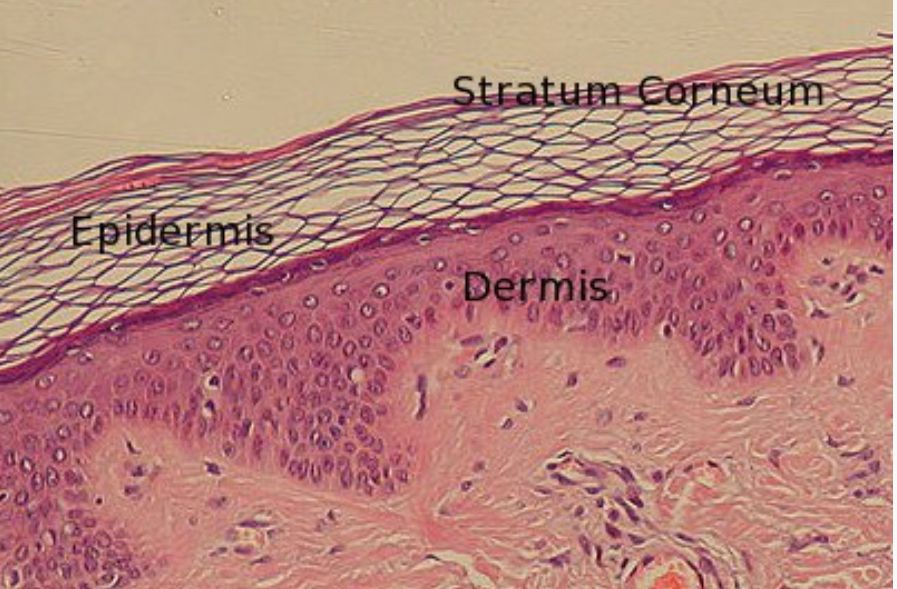
The stratum corneum is the outermost layer of the epidermis. It is often described using the "brick and mortar" model: corneocytes form the relatively solid structural elements, while intercellular lipids surround them.
This structure is essential for protecting the body from the external environment, but it also makes topical delivery difficult.
For an ingredient applied to the skin, the stratum corneum is therefore not simply a surface to pass through. It is a selective barrier.
The ability of a molecule to move through this barrier depends on several properties, including its molecular size, polarity, solubility and affinity for the skin.
The Dermal Absorption and Toxicity Assessment literature identifies factors such as molecular size, solubility and polarity as important determinants of dermal absorption. It also notes that the stratum corneum is commonly considered the rate-limiting barrier for many compounds. (Dermal Absorption and Toxicity Assessment, 2nd ed., 2008, Michael S. Roberts & Kenneth A. Walters, eds.)
That immediately explains why putting more of an ingredient into a formula does not automatically solve a delivery problem.
What Happens After You Apply a Cosmetic?
The journey of an active ingredient can be thought of as a series of steps.
First, the ingredient has to be released from the formulation.
It then reaches the skin surface and interacts with the stratum corneum. Some of it may remain near the surface, some may enter the stratum corneum, and some may move further into the viable epidermis or dermis.
A portion may also be lost through evaporation, removed by washing or remain associated with the formulation.
The important point is that the amount applied to the skin and the amount delivered to a particular skin layer are not the same thing.
The Delivery System Handbook for Personal Care and Cosmetic Products describes topical delivery in terms of getting the right active to the right site, at the right concentration and for the appropriate period of time. It also highlights the difficulty of measuring exactly where an active is located within the different skin layers. (Delivery System Handbook for Personal Care and Cosmetic Products, 2005, Meyer R. Rosen, ed.)
Does Molecular Size Matter?
Yes.
Molecular size is one of the important factors influencing skin penetration.
In general, smaller molecules tend to have an advantage when moving through the stratum corneum compared with larger molecules. Research discussed in Dermal Absorption and Toxicity Assessment identifies molecular size as an important determinant of maximum flux across skin.
But molecular size is only part of the picture.
Two molecules of similar size can behave very differently if their polarity, solubility or interaction with the formulation and skin are different.
This is why it is difficult to predict skin delivery from a single ingredient property.
The molecule and the formulation have to be considered together.
Why Polarity Matters
The stratum corneum has a complex lipid structure, so an active ingredient's affinity for water and oil can strongly influence its behaviour.
A very hydrophilic molecule may have difficulty moving through the lipid-rich regions of the stratum corneum.
A highly lipophilic molecule may enter the stratum corneum but become strongly associated with it instead of moving further into the skin.
This creates an interesting formulation problem.
The ideal delivery system is not necessarily the one that makes the active as soluble as possible.
It needs to create an appropriate balance between solubility in the vehicle, release from the formulation and partitioning into the skin.
The delivery-system literature discusses this relationship in detail and introduces the concept of a relative polarity index (RPI) to help assess the relationship between the penetrating molecule, the skin and formulation components.
The Formulation Can Change Skin Delivery
This is perhaps the most important point for cosmetic product developers.
An active ingredient does not behave independently of its vehicle.
The same active can show different skin-delivery behaviour when incorporated into different formulations.
The Delivery System Handbook specifically examines the effects of formulation type, emollients and emulsifiers on skin delivery. It describes formulation mapping as a way of investigating how different formulations influence the penetration and distribution of an active.
This means that changing an emollient is not necessarily just a change in texture.
It can potentially change how an active interacts with the vehicle and subsequently how it is delivered to the skin.
Why Emollients Matter
Imagine a lipophilic active incorporated into an oil phase.
The active needs to be sufficiently soluble in that phase to allow the product to remain physically stable. But if the active is held too strongly by the vehicle, that can potentially reduce its tendency to leave the formulation and partition into the skin.
This creates a formulation balance.
The Delivery System Handbook describes the importance of selecting primary and secondary emollients when optimising the delivery of an active from an emulsion.
This is one of the reasons why simply increasing the concentration of an active does not necessarily provide a proportional improvement in delivery.
The relationship between the active and the surrounding formulation can be more important than the number printed on the ingredient list.
An Interesting Example: More Active Does Not Always Mean More Delivery
The book Dermatologic, Cosmeceutic, and Cosmetic Development presents a particularly useful example of this principle.
Researchers compared formulations containing the same active but with different formulation designs. A delivery-optimised formulation produced substantially greater skin delivery and greater clinical efficacy than a formulation that had not been optimised for delivery.
Even more interestingly, reducing the concentration of the active while maintaining the appropriate relationship between the active and the oil-phase components did not necessarily eliminate the clinical benefit.
The example demonstrates a broader principle:
The performance of an active ingredient depends not only on how much is present, but also on how the formulation delivers it.
This concept is described in the book as "formulating for efficacy." (Dermatologic, Cosmeceutic, and Cosmetic Development: Therapeutic and Novel Approaches, 2008, Kenneth A. Walters & Michael S. Roberts, eds.)
Get the latest posts
Unlock a world of knowledge and inspiration - subscribe to our blog for exclusive content, expert insights, and exciting updates!
What Role Do Emulsifiers Play?
Emulsifiers are usually discussed in terms of keeping oil and water together.
But their role can extend further.
When an active ingredient is incorporated into an emulsion, the emulsifier influences the interface between the oil and water phases. That can affect where the active resides within the formulation and how readily it becomes available to interact with the skin.
The Delivery System Handbook specifically considers the influence of emulsifiers on dermal delivery.
This is a good example of why formulation development cannot always be divided into separate boxes.
An ingredient selected for stability may also influence delivery.
An emollient selected for sensory properties may influence penetration.
A surfactant selected for emulsification may affect the interaction between the formulation and the skin.
A successful formulation has to balance all of these considerations.
Does a Delivery System Always Increase Penetration?
No.
This is an important distinction.
Liposomes, nanoemulsions, microemulsions, polymeric systems and other delivery technologies can be designed to modify how an active behaves in a formulation and at the skin surface.
But "advanced delivery system" does not automatically mean "better penetration".
The appropriate system depends on the active ingredient and the intended target.
For example, a delivery system may be designed to:
- improve the solubility of an active;
- protect an unstable ingredient;
- control its release;
- increase its contact with the skin;
- alter its distribution within the formulation;
- or improve its deposition in particular skin regions.
In some cases, the goal may actually be to keep an ingredient within the skin rather than maximise systemic absorption.
This distinction is particularly important for cosmetic products, where the desired activity is generally local rather than systemic.
Reaching the Skin Is Not the Same as Crossing It
The terms penetration, permeation and absorption are sometimes used interchangeably, but they describe different concepts.
An ingredient can enter the stratum corneum without necessarily passing completely through the skin.
It may also accumulate within the skin, creating what is sometimes described as a skin reservoir.
For topical product development, this can be highly relevant.
The objective may not be to push an ingredient through the skin and into systemic circulation. Instead, the desired outcome can be local delivery to the appropriate skin compartment.
This is why measuring only the amount that crosses the entire skin does not always tell the complete story.
The Delivery System Handbook points out that many techniques measure the amount of a penetrating molecule in the skin as a whole without necessarily determining its distribution between the stratum corneum, viable epidermis and dermis. (Delivery System Handbook for Personal Care and Cosmetic Products, 2005, Meyer R. Rosen, ed.)
How Is Skin Delivery Measured?
Skin penetration cannot be judged reliably just by looking at the finished product.
Laboratory methods can be used to investigate how an ingredient moves through skin.
One established approach is the diffusion cell, including Franz diffusion cells.
In these studies, a formulation is applied to a skin sample and the movement of the test substance is measured over time.
Other approaches can examine how much of an ingredient remains within different skin layers.
The Delivery System Handbook describes both in vitro and in vivo approaches, including diffusion cells, human volunteers and different skin models.
The choice of model matters.
Human skin, animal skin and reconstructed skin models do not necessarily behave identically. The Dermal Absorption and Toxicity Assessment literature notes that animal skin can produce substantially different absorption characteristics from human skin, which is one reason experimental conditions and model selection need careful consideration.
Why Formulation Development Matters More Than the Ingredient List
This leads to a broader lesson in cosmetic formulation.
A skincare product should not be judged solely by the presence or concentration of a fashionable active ingredient.
Two products can contain the same active at the same concentration and still behave differently because their formulations are different.
The surrounding formulation determines the chemical environment of the active, its solubility, release, interaction with the skin and, potentially, its delivery.
This is why professional formulation development considers the active and its vehicle as one system.
The question is not simply:
"How much active ingredient is in the product?"
It is also:
"What happens to that active after the product is applied?"
The Bottom Line
Getting a cosmetic active to the skin is easy.
Getting it to behave exactly as intended once it reaches the skin is much more complicated.
The stratum corneum provides a powerful barrier, and an active's molecular size, polarity and solubility all influence its ability to move through it.
But the formulation can change the outcome significantly.
Emollients, emulsifiers, the oil-water balance, delivery systems and the physical structure of the product can all influence how an active is released from the formulation and interacts with the skin.
For this reason, effective cosmetic formulation is not simply about selecting a powerful active ingredient.
It is about designing the entire system around that ingredient.
The most sophisticated formula is not necessarily the one with the most advanced technology. It is the one in which the ingredient, formulation, delivery system and intended site of action are properly matched.
That is where formulation science can turn an interesting active ingredient into a genuinely well-designed cosmetic product.
References
- Roberts, M. S., & Walters, K. A. (Eds.). (2008). Dermal Absorption and Toxicity Assessment, 2nd ed. Informa Healthcare.
- Walters, K. A., & Roberts, M. S. (Eds.). (2008). Dermatologic, Cosmeceutic, and Cosmetic Development: Therapeutic and Novel Approaches. Informa Healthcare.
- Rosen, M. R. (Ed.). (2005). Delivery System Handbook for Personal Care and Cosmetic Products: Technology, Applications, and Formulations. William Andrew Publishing.
Related posts
Cosmetic Emulsions: Formulation, Common Emulsifiers & Stability Insights