Cosmetic Product Stability: How Long Do Skincare Products Really Last?

Keeping a cosmetic product in this condition is one of the challenges of formulation stability.
But stability does not mean that a product must remain absolutely unchanged forever. In practice, the goal is to make sure that the product remains safe, functional and acceptable to the consumer throughout its intended shelf life. (Handbook of Cosmetic Science and Technology, 2001, André O. Barel, Marc Paye and Howard I. Maibach, eds.)
What does stability mean in cosmetics?
A cosmetic product can change in several different ways over time.
The most obvious changes are often the ones we can see or feel:
- a cream becomes thinner or thicker;
- an emulsion begins to separate;
- the colour changes;
- the fragrance becomes different;
- crystals appear;
- the product becomes difficult to dispense.
But not every important change is immediately visible.
An active ingredient can gradually degrade, the preservation system can become less effective, or the interaction between the formulation and its packaging can change.
This is why stability testing looks at more than just whether a product still “looks good.” The relevant characteristics depend on the particular formulation and what the product is intended to do. (Handbook of Cosmetic Science and Technology, 2001, André O. Barel, Marc Paye and Howard I. Maibach, eds.)
Why do cosmetic products change over time?
There is no single reason.
A formulation can be affected by temperature, light, oxygen, moisture, pH and interactions between ingredients.
For example, some ingredients are particularly sensitive to oxidation. Others can be affected by changes in pH or temperature. Even ingredients that are individually stable may behave differently when combined with other components in a complex formulation.
This is particularly important for products containing sensitive active ingredients.
The formulation therefore has to be designed not only for how the product performs immediately after manufacturing, but also for how it is expected to behave during storage.
What about creams and emulsions?
Emulsions are a particularly good example of why stability can be challenging.
A cream containing both oil and water is designed to keep those two phases together. But an emulsion is inherently a delicate system, and changes can occur over time.
You may see:
- separation of oil and water;
- changes in viscosity;
- creaming;
- changes in droplet size;
- or, eventually, complete breakdown of the emulsion.
Temperature changes can make these problems more apparent. Freeze/thaw conditions, for example, can expose weaknesses in an emulsion that may not be obvious under normal storage conditions. Stability testing can therefore be used during development to identify problems and help the formulator adjust the formula. (Handbook of Cosmetic Science and Technology, 2001, André O. Barel, Marc Paye and Howard I. Maibach, eds.)
Stability is not just about the formula
This is an important point that is sometimes overlooked.
A formula can be perfectly designed in the laboratory and still behave differently when it is manufactured on a larger scale.
During scale-up, the amount of energy applied during mixing, the heating and cooling rates, the order in which ingredients are added and other processing conditions can change.
For emulsions in particular, the manufacturing process can influence the size and distribution of droplets, which in turn can affect stability.
That is why stability testing should not be limited to a small laboratory sample. Testing a representative production batch can reveal problems that would otherwise only appear after commercial manufacturing has begun. (Handbook of Cosmetic Science and Technology, 2001, André O. Barel, Marc Paye and Howard I. Maibach, eds.)
Packaging can affect stability too
The bottle, tube, jar or pump is not simply there to make the product look attractive.
The packaging becomes part of the product system once the formula is filled into it.
Different packaging materials have different properties. For example, plastics can differ in oxygen permeability and thermal resistance, while certain ingredients can interact with packaging materials.
Even changing the supplier of a packaging component can justify additional evaluation if the material properties are different.
The Handbook of Cosmetic Science and Technology therefore recommends evaluating the combination of the formulation and its intended packaging rather than treating the two completely separately. (Handbook of Cosmetic Science and Technology, 2001, André O. Barel, Marc Paye and Howard I. Maibach, eds.)
This can be particularly important for products containing sensitive ingredients or formulations that are affected by oxygen, light or temperature.
Legyen naprakész
Fedezze fel a tudás és az inspiráció világát - iratkozzon fel blogunkra, hogy exkluzív tartalmakat és izgalmas híreket kapjon a szépségipar világából!
How is cosmetic stability tested?
Stability testing essentially asks a simple question:
What happens to this product when it is exposed to the conditions it may experience during its lifetime?
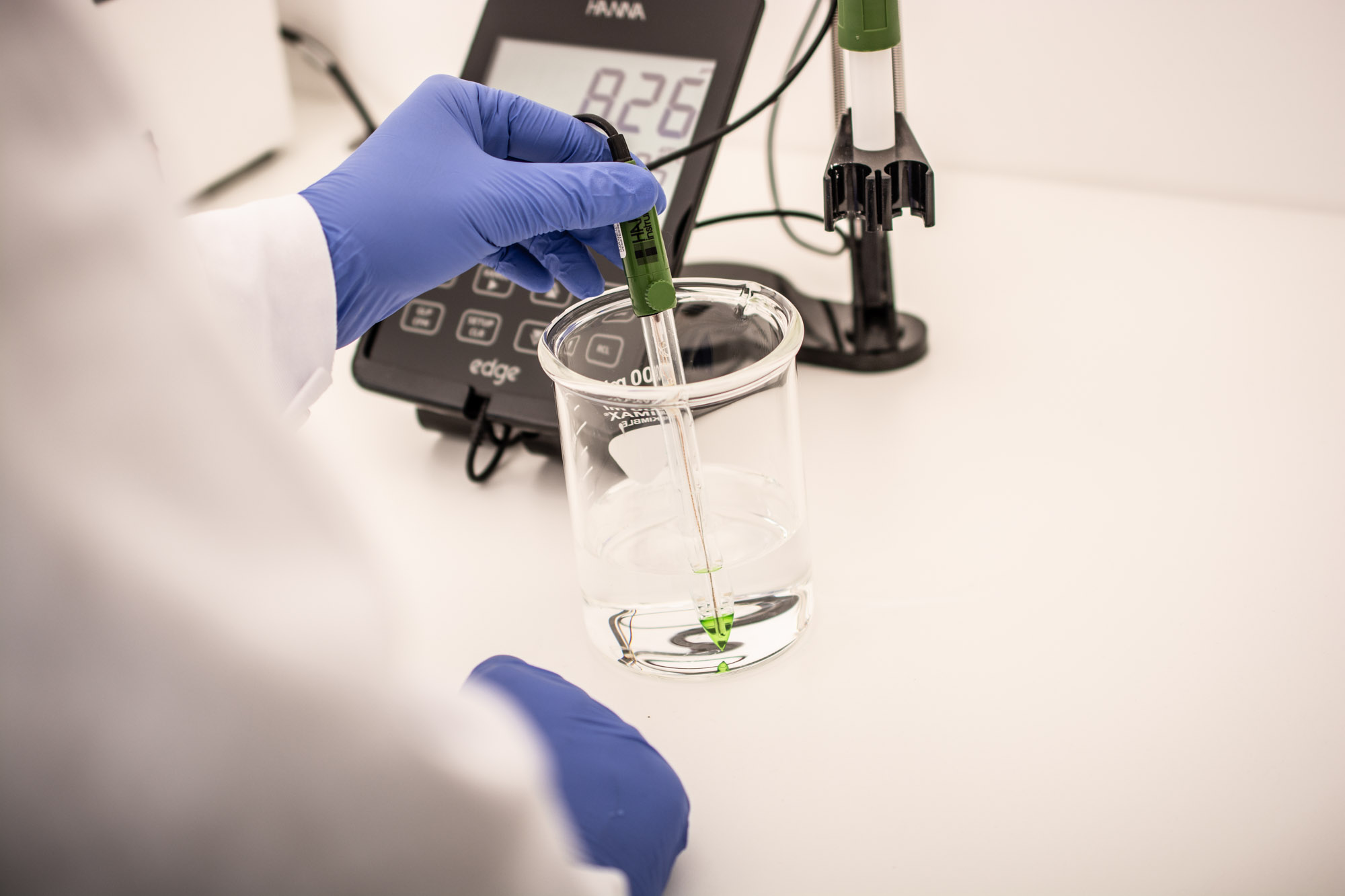
Samples can be stored under different conditions and monitored over time.
Depending on the product, the evaluation can include things such as:
- appearance and colour;
- odour;
- viscosity and texture;
- pH;
- physical separation;
- active ingredient stability;
- microbiological condition;
- packaging compatibility.
Accelerated conditions can also be used to expose potential problems more quickly than would be possible under normal storage conditions.
The results can help formulators identify weaknesses in the formula before the product reaches the market. Importantly, stability testing is not a guarantee that absolutely nothing will ever change. Rather, it provides evidence that any changes remain within acceptable limits for the intended product. (Handbook of Cosmetic Science and Technology, 2001, André O. Barel, Marc Paye and Howard I. Maibach, eds.)
Why is stability testing important during development?
Stability testing is not something that only happens at the very end of product development.
It can actually help the formulator improve the formula.
Imagine that a new cream begins separating during a freeze/thaw test. That result provides useful information. The emulsifier system, oil phase or processing conditions may need to be adjusted, and the revised formulation can then be tested again.
In this way, stability testing becomes part of the development process rather than simply a final pass-or-fail exercise.
The same principle applies when a raw material is changed. Even if a replacement ingredient appears to be equivalent, differences between suppliers or manufacturing processes can affect the stability of the finished formula. (Handbook of Cosmetic Science and Technology, 2001, André O. Barel, Marc Paye and Howard I. Maibach, eds.)
So, how long does a skincare product really last?
There is no universal answer.
The shelf life of a cosmetic product depends on its specific formulation, packaging, manufacturing process and storage conditions.
Two products that look very similar can have completely different stability profiles.
This is why it would be misleading to say that, for example, “all face creams last two years.” The appropriate shelf life needs to be established for the individual product based on suitable stability and safety considerations.
The intended storage conditions matter as well. A product that is stable under controlled room-temperature conditions may behave differently if it is repeatedly exposed to high temperatures, freezing conditions or direct sunlight.
What happens when a formula is changed?
This is another reason why stability is an ongoing consideration.
Replacing a raw material, changing its supplier, modifying the manufacturing process or switching packaging can potentially alter the stability of an established formula.
A seemingly minor change may have no noticeable effect — or it may create an unexpected problem.
For this reason, stability evaluation can be necessary after significant changes to the formula, manufacturing process or packaging. (Handbook of Cosmetic Science and Technology, 2001, André O. Barel, Marc Paye and Howard I. Maibach, eds.)
The role of formulation expertise
A stable cosmetic product does not happen by accident.
The formulator has to think about the product as a complete system: ingredients, formulation structure, manufacturing process, packaging and intended storage conditions all interact with one another.
This is especially important when developing products containing sophisticated active ingredients or complex delivery systems.
At A&T Formulation, stability is therefore considered as part of the development process from the beginning. A formulation needs to do more than work in the laboratory on the day it is made. It needs to remain fit for purpose throughout its intended life as a finished cosmetic product.
The key takeaway
A cosmetic product does not need to remain literally unchanged forever. What matters is that it remains safe, functional and acceptable to use throughout its intended shelf life.
Temperature, oxygen, light, ingredients, manufacturing conditions and packaging can all influence stability.
That is why stability testing is such an important part of cosmetic product development. It helps identify potential problems before they reach the consumer — and, just as importantly, it gives the formulator information that can be used to create a better and more reliable product.
Kapcsolódó bejegyzések
Cosmetic Emulsions: Formulation, Common Emulsifiers & Stability Insights